Choosing an upright comfort or cruiser bicycle for short, flat, unhurried riding
Step-through or step-over? What the frame shape changes, and what it doesn't
Standover clearance, saddle height and frame flex are three separate questions, and only one of them is really settled by the shape of the top tube.
El Paseo Cruisers
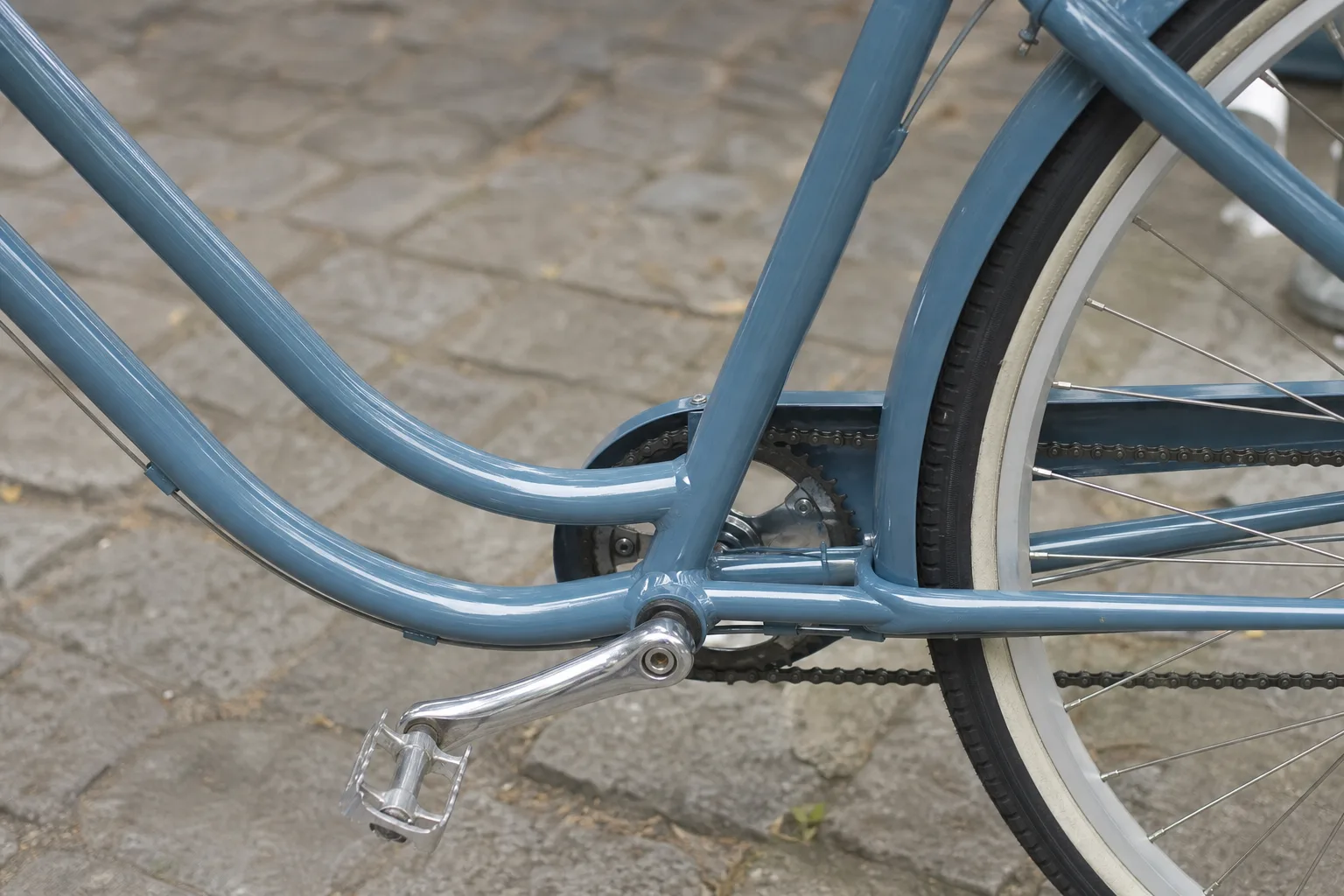
The choice between a step-through frame and a conventional diamond frame gets discussed as though it were a question of style, or of what kind of rider you are, when in practice it settles exactly one mechanical question and leaves two others open. It decides how much room there is between your inseam and the top tube when you stand flat-footed over the bike. It does not decide your saddle height, and it barely touches your reach. A careful reader separates those three, because conflating them is how people end up on a bike that fits at a stoplight and nowhere else.
Standover clearance is a dismount question, not a pedaling question
Standover height is measured from the ground to the top of the top tube at roughly the point where you would straddle the bike. On a step-over frame with a level top tube, that number lands somewhere near the middle of most adults' inseams, and an inch or two of clearance is the usual target. On a step-through, the number falls low enough that clearance stops being a measurement at all. What that buys you is narrow but real: you can stop, put both feet down, and step off sideways without swinging a leg over the saddle, on every single stop of every ride.
For short, flat, unhurried riding, that adds up. A three-mile errand through a town center might involve fifteen or twenty stops, and each one is a small negotiation with hip mobility, with a skirt or a work bag, with a curb that sits higher than you expected. None of it is dangerous on a step-over frame for a rider who moves easily. It just costs a little attention each time, and a step-through frame returns that attention to the road. The Consumer Product Safety Commission is the federal body responsible for bicycle safety requirements in the United States, and both frame styles are built to the same rules.
Saddle height is the dimension that actually governs efficiency
Here is where riders go wrong. Because a step-through frame looks low, people set the saddle low to match, and then wonder why a flat two-mile ride leaves their knees complaining. Saddle height is set by leg length, not by frame shape, and the workable range is narrow. With the pedal at the bottom of its stroke and your heel resting on it, your leg should be nearly straight, which leaves a slight bend when the ball of your foot is in the riding position. Drop the saddle much below that and the knee never opens up.
The cost of dropping the saddle is not linear, and it does not announce itself immediately. An inch below your proper height feels fine for a few blocks and merely tiring after two miles. Two inches below, the knee stays flexed through the whole stroke, the quadriceps do work the glutes should be doing, and pedaling gets noticeably heavier on the slightest rise. If you want to put a foot down without leaving the saddle, buy the frame that lets you step off instead of the seatpost position that ruins your stroke.
What removing the top tube costs in stiffness
A diamond frame is a pair of triangles, and triangles are what keep a frame from twisting under load. Take out the top tube, or drop it into a deep curve, and the front triangle stops being a triangle. Manufacturers compensate with larger-diameter tubing, thicker walls, a doubled or heavily curved down tube, or a stouter head tube junction, and the compensation works. What it costs is a small amount of torsional stiffness and, usually, a pound or two of weight. On a flat street at nine miles an hour, neither is something you will feel.
Where you might feel it is standing up to accelerate hard, carrying a heavy front basket, or loading a rack past its rating. If that describes your riding, look for a step-through with a deep, curved down tube or a mixte-style pair of thin tubes running from the head tube back to the rear dropouts, which restores much of the triangulation without raising the standover.
The five-minute check in the shop
Straddle the bike flat-footed in ordinary shoes and note the clearance. Set the saddle by the heel method, tighten the quick release, and then try to put a foot down while seated. If you cannot, that is expected and correct. Sit and reach for the grips, checking that your elbows stay slightly bent and your wrists are not cranked outward. Then ride it, and swing a leg over as you dismount. That last movement, repeated a few times in the parking lot, tells you more than any measurement on the spec sheet.
A step-through frame solves a specific, recurring inconvenience without asking you to compromise the saddle height that keeps pedaling easy. That is a clean trade, and worth making deliberately rather than by default.