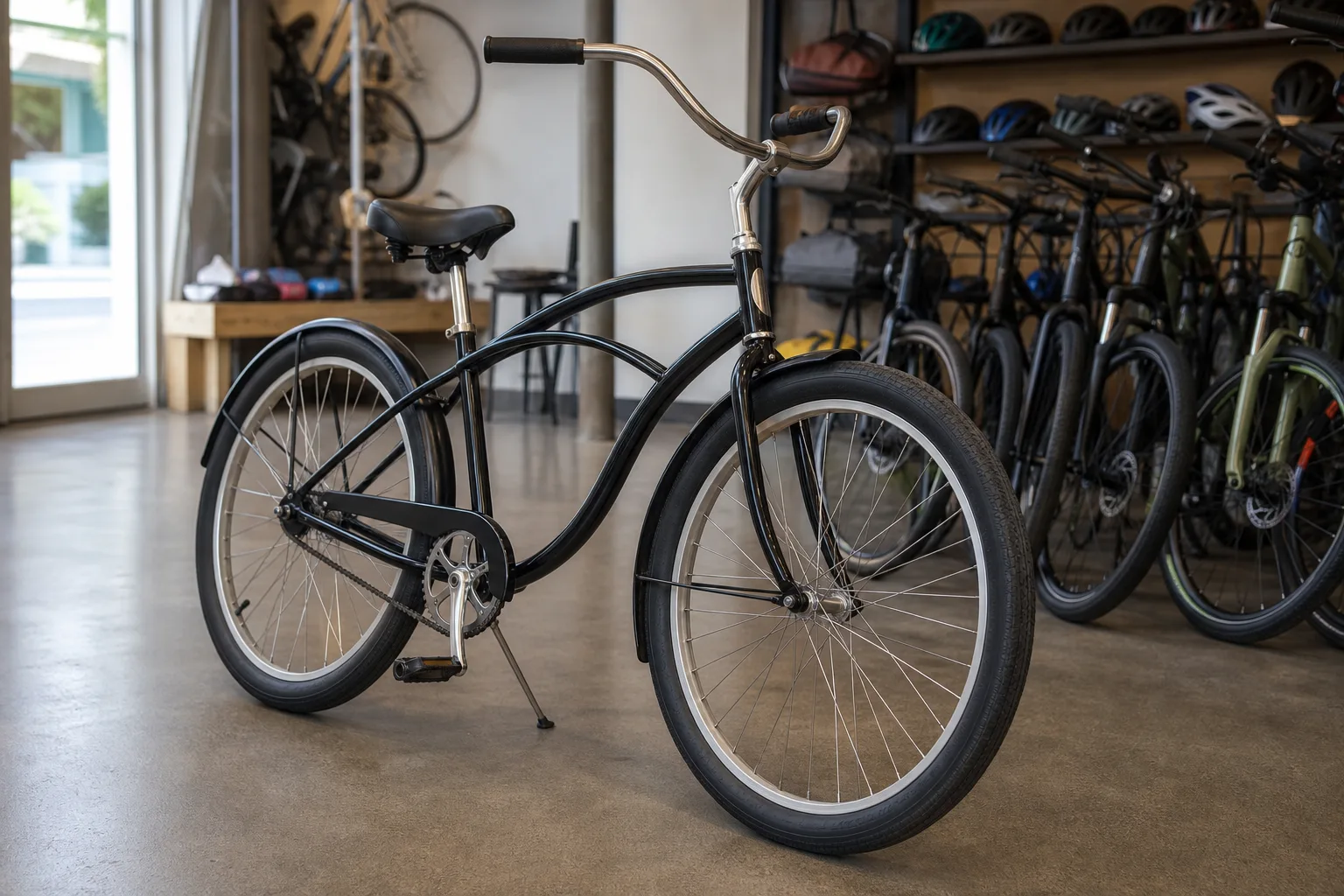
A cruiser is a set of deliberate trades, and every one of them was made in favor of the first ten minutes of a ride rather than the last thirty. The swept-back bar pulls your hands behind the steering axis so your back sits close to vertical. The wide sprung saddle carries weight on the sit bones instead of spreading it between hands, feet and seat. The balloon tires, usually 2.125 inches on a 26-inch rim, run soft enough to swallow expansion joints. Each choice buys comfort at low speed and charges for it somewhere else.
The riding the geometry was drawn for
Picture the trip honestly: a mile and a half to a coffee shop, two miles to the beach path, three miles across town to a friend's place, all of it on ground that never rises more than a highway overpass. That is the envelope. Speeds sit somewhere between eight and twelve miles an hour, which is fast enough to feel like travel and slow enough that wind resistance never becomes the dominant force working against you. Stops are frequent, the route is familiar, and you are wearing whatever you were already wearing. In that envelope the upright bike is not a compromise. It is the correct tool.
The clothing point deserves more weight than it usually gets. An upright riding position keeps your torso off the bar, which means a skirt, a work shirt or a pair of loose linen pants behaves normally instead of catching wind or riding up. A chain guard keeps grease off a cuff. Fenders keep a stripe of street water off your back. None of that is decorative, and none of it matters at all on a bike you would change clothes to ride. The cruiser's real function is removing the preparation step between deciding to go and going.
What the comfort actually costs
Weight is the first bill. A steel cruiser frame with a wide saddle, fenders, a chain guard and heavy tires commonly lands somewhere in the high thirties to mid forties of pounds, which is fifteen or twenty pounds more than a plain hybrid of similar price. On flat ground that mass is nearly invisible once you are rolling, since you are not accelerating hard or often. Carrying the bike up a flight of apartment stairs is a different experience, and so is lifting it onto a trunk rack. Judge the number by how the bike will be stored, not by how it rides.
The second bill is rolling resistance and gearing. Soft, wide tires at thirty to forty psi deform more against pavement than a narrower tire at seventy, and that deformation is energy you supplied. A single speed geared for relaxed flat cruising gives you no answer when the ground tilts, because there is nothing to shift into. The upright position also puts your chest square into the air, which is fine at nine miles an hour and increasingly expensive above fifteen. These costs compound quietly: any one is trivial, and together they define the edge of the envelope.
Where the ground argues for a different bike
The clearest signal is a repeated grade. If the route home includes a climb that lasts more than a few blocks, or rises more than roughly a hundred feet, a single-speed cruiser will make you walk it, and walking a forty-pound bike in street shoes stops being charming around the third week. Distance is the second signal. Past four or five miles each way, the seated pressure that felt generous in mile one becomes the thing you notice, because a wide saddle spreads load but also limits how much you can shift position. A bike with gears, a narrower saddle and a slightly forward lean costs comfort at minute five and returns it at minute forty.
Cargo is the quieter signal. A cruiser with a rear rack handles a bag of groceries or a beach chair without complaint, but a weekly full-size shopping run, a child seat, or a commute with a laptop and a change of clothes loads the rear wheel in ways a lightly built wheel and a coaster brake were not drawn for. The Consumer Product Safety Commission is responsible for the federal requirements that govern bicycles sold in the United States, including braking and reflector rules, and those requirements are a floor rather than a description of what a given wheel and brake will happily carry every day.
Making the trade with open eyes
Ride the actual route before you buy, on a demo bike if you can get one, and pay attention to the two or three worst moments rather than the pleasant middle. If the worst moment is a slight rise you can stand up over, a single speed is fine. If it is a real hill, buy gears now instead of retrofitting later. Sizing matters more than model name, and a women's beach cruiser is generally built around a lower standover and a shorter reach, which is worth checking against your inseam and arm length directly.
Set the saddle where your leg is nearly straight at the bottom of the stroke, then decide whether you still want both feet flat on the ground at a stop. You usually cannot have both, and on a bike used for short trips with frequent stops, many riders knowingly give up an inch of pedaling efficiency to keep the confident foot-down stop. State the trade, choose it, and the bike will do what you bought it for.